
The selection of an upholstery material for automobiles involves much more than evaluating its aesthetic appeal, tactile properties, or sustainability claims. Automotive interior materials must withstand occupant interaction, friction, bending, sunlight, temperature changes, humidity, cleaning processes, and high performance expectations, while also meeting safety, air-quality, manufacturability, quality-standard, and aesthetic requirements. A material that seems satisfactory when viewed as a small sample could easily prove to be inappropriate for a specific part or vehicle program.
There is no single standardized definition that covers all sustainable leather alternatives used in automotive interiors. Specifications change based on the part, the geographical market, the OEM (Original Equipment Manufacturer), the Tier 1 supplier, the part’s construction, the testing program, and even program revisions. Potential assessment criteria can include flammability, abrasion resistance, weathering, VOC emissions, fogging, cleanability, color uniformity, manufacturability, and availability.

UNCAGED Innovations manufactures ELEVATE material, which is a leather substitute made from grain protein using its BioFuze process. The collaboration with Hyundai CRADLE and JLR in the public domain is relevant to applying materials in the automotive industry.
Start With the Interior Application and Requirements
Define how the material will perform in terms of the vehicle program before sampling. Differentiate between non-negotiables and preferences related to design and business. Requirements such as safety, durability, emissions, chemical constraints, and other OEM-specific criteria might be determinants of whether or not a material will be viable. However, issues related to color, grain, gloss, softness, and feel should be considered later on.
The evaluation of the exact version of the material in question is also a critical step. A result obtained in one combination of material form, backing, coating, or component set-up might not apply to another combination. Documenting the material version, specification revision level, testing procedures, and requirements status can ease collaboration among engineering, design, sustainability, procurement, and manufacturing teams.
Map the Component, Contact Level, and Exposure
Start by looking at precisely which area of the interior the material will be used. An automotive seat upholstery material used on a seat cover will face different stresses from a door panel, headrest, or decorative trim, so assess each material for its specific use rather than as “car interiors” in general.
Consider:
- the frequency of touching and rubbing of the surface;
- bending, stretching, compression, or other stresses of the material;
- sunlight, temperature variations and heat;
- moisture, condensation and humidity;
- contact with skin oil, sweat, makeup, food and cleaning agents;
- visibility of the surface and need for color uniformity;
- stitching, wrapping, laminating or other methods of construction; and
- service life of the component.
A material can behave quite differently based on its application and usage. A material that is in constant contact with people may need more wear and cleaning resistance than a decorative surface. Wrapping, stitching, lamination, and other complex construction can also add stress to the material. If the application changes, the testing criteria should also be re-evaluated.
Separate Critical Requirements From Design Preferences
Before comparing options, split requirements into two categories: those that can disqualify a material and those that can fine-tune the selection. This will help the team concentrate on the crucial criteria first instead of discussing color, grain, and other non-technical aspects before confirming the requirements.
In order to make the decision process more effective, it is recommended to sort the criteria in the following way:
- Critical requirements include safety requirements, OEM/Tier 1 requirements, durability, interior emissions, restricted substances, and suitability for the manufacturing process.
- Commercial requirements: availability, material forms, MOQ, lead times, pricing model, manufacturing location, and manufacturing capability.
- Design requirements include feel, grain, gloss, color, drape, structure, stitching, embossing, and edge finish.
- Sustainability requirements include bio-content certification, life cycle assessment data, sourcing, certifications, and end-of-life data.
Any requirement that can make it impossible to approve the material for the vehicle program must be a pass/fail criterion. Premium leather-like feel cannot be used to make up for lack of flammability data, just like excellent sustainability claims cannot substitute for durability data.
Build the OEM or Tier 1 Specification Before Sourcing
Before contacting suppliers or comparing materials, develop the vehicle program into a specification. This way everyone will have something to reference, and it becomes much simpler to determine whether the material is suitable for prototyping or not.
Here’s how it goes:
- Name the component and the vehicle program.
- Identify the markets where the vehicle will be sold.
- Get the OEM or Tier 1 material specification and the corresponding revision.
- List all the tests, test conditions, and pass/fail criteria.
- Identify the full component construction (substrate, foam, backer, adhesives, and adjacent materials if applicable).
- Include appearance, haptics, color, texture, and gloss along with manufacturing specifications.
- Establish documentation, traceability, chemical, quality system, and other requirements.
- Create a list of all the items you need to include in a specification and fill it out for each candidate material.
The test method does not mean the customer specification. For example, SAE J2412 specifies accelerated xenon-arc exposure of automotive interior trim, but each manufacturer is free to specify different exposure times and exceptions.
Define Haptics, Grain, Color, and Surface Design
After the list of non-negotiable technical specifications has been defined, consider the attributes that influence the way the material is experienced both tactilely and visually inside the automobile. For an automotive seat material, these could include hand-feel, grain structure, gloss, color fidelity, color uniformity, perceived quality, stitching definition, edge definition, embossing, and the way the surface follows the contours of the component.
These attributes are far more than simply decorative. A surface that appears uniform when applied to a flat panel could look completely different when applied over a radius or when juxtaposed against other trim materials. Color and gloss should also be expected to remain consistent from batch to batch and following designated aging or exposure testing.
UNCAGED claims that the ELEVATE material is customizable in terms of its thickness, texture, color, durability, flexibility, and surface quality through its material technology. However, this does not imply that a customized material necessarily meets the needs of an automotive specification.
Create a Pass/Fail Material Requirements Matrix

A shared requirements matrix will simplify the entire process for everyone. Without depending on how things have appeared in a sample, the team can clearly understand what has been verified, what is missing, and what may be a barrier to further progress with the content.
| Requirement area | Typical question | Evidence to record | Decision status |
|---|---|---|---|
| Safety | Does the component construction meet the required flammability limits? | Test method, specification revision, specimen construction, result | Pass, fail, pending |
| Durability | Can the surface handle the expected wear and exposure? | Abrasion, flex, aging, colorfastness, cleaning, or other required tests | Pass, fail, pending |
| Cabin air | Are emissions and fogging within the required limits? | Program-specific VOC, carbonyl, odor, or fogging data | Pass, fail, pending |
| Manufacturing | Can the material work with the intended production process? | Cutting, stitching, bonding, forming, and assembly trial results | Pass, fail, pending |
| Appearance | Does it meet the required color, gloss, grain, and tactile targets? | Approved master, tolerances, and prototype review | Pass, fail, pending |
| Sustainability | Are the claims supported at the required scope? | LCA, biobased content, certification, and sourcing documentation | Accepted, incomplete |
| Supply | Can the supplier support the program commercially? | Format, MOQ, lead time, capacity, quality, and change-control data | Accepted, incomplete |
Always identify the exact formulation and revision in the matrix. If the material changes later, the team can immediately see which results may need to be reviewed or repeated.
Compare Materials Across the Criteria That Matter
A sample may make a good first impression; however, it does not convey all the information needed. The structure of a material influences its performance and processing. The test results will only be meaningful in case the method of testing, the specimen, the formulation, and the limit of acceptability are known. Sustainability statements must have an agreed scope, and the manufacturing data should be consistent with the process used.
The best comparison takes into account all of the above aspects. This case study shows why this matters: UNCAGED offers useful information on the construction, performance, sustainability, and processing of ELEVATE. However, these data points must still correspond to the needs of the automotive project in question.
| Evaluation criterion | Evidence to request | Red flag | Decision rule |
|---|---|---|---|
| Construction | Layer structure, backing, coating, formulation ID | Vague or changing description | Test the exact construction intended for the program |
| Durability | Named methods, conditions, results, thresholds | Only generic marketing language | Keep qualification open until required tests are complete |
| Safety and cabin air | Applicable regulatory or OEM reports | No clear link to formulation or component | Do not assume compliance |
| Manufacturing | Trial data from real processes and assemblies | Sample only, no process trial | Prototype before nomination |
| Sustainability | LCA scope, biobased evidence, certifications | Broad “eco” claims without scope | Compare like-for-like evidence |
| Supply and quality | Format, capacity, consistency, change control | Prototype supply only | Resolve commercial risks before nomination |
Check Material Architecture and Composition
First, what does it consist of, and how are its layers composed? In coated or composite materials, the material’s surface, core structure, backing, adhesives, and other interfaces may affect performance, durability, processing, emissions, and testing.
A plant based leather construction can combine bio-based and synthetic layers, so the exact architecture matters. UNCAGED says that ELEVATE is a multilayer material that features the top layer of BioPU coating, the grain-based core, and the plant-based fabric layer. On its material construction page, the approximate thickness of its layers is described as follows: top coat – 0.01 mm, grain-based core – 0.4 to 0.8 mm, and fabric layer – 0.3 to 0.5 mm. Also, UNCAGE states that its grain-protein formulation may be changed depending on specific properties.
Such technical information is very useful for understanding the platform, yet an automotive team needs to obtain the current technical data regarding the particular version of material. A signature sample or the website specifications cannot be considered sufficient for every custom automotive formulation.
Verify Abrasion, Flex, Aging, and Surface Durability
“Durable” is too vague to have any real meaning. One type of wear may be resisted while others are not, so the test regime must consider the actual stress to which the component will be exposed.
This may involve the following, depending on the program:
- abrasion and surface wear;
- flex resistance;
- tensile resistance if necessary;
- colorfastness and crocking;
- heat and light aging;
- environmental exposure;
- soilability and cleanability resistance;
- hydrolytic resistance if necessary;
- seaming or stitch resistance for sewn materials.
SAE J948 is an example of an automotive test for abrasion, while SAE J2412 is an example of an accelerated xenon-arc light exposure test. Not all automotive programs will use these tests, however.
UNCAGED indicates that ELEVATE exceeds 10,000 Martindale abrasion cycles and 100,000 Bally Flex cycles, as well as 16 hours of water-resistance testing. These can help with initial screening, but automotive qualification depends on the specific test, formulation, sample, threshold, and program requirements.
Check Flammability, VOCs, Fogging, and Cabin-Air Needs
Vehicle interiors present additional considerations with respect to safety requirements and cabin air quality that might not be as pertinent in other industries. Testing requirements vary based on the application, market, OEM, and construction of the component.
Testing should consider at least:
- flammability or burning properties;
- VOCs, formaldehyde, and other carbonyls;
- odor requirement;
- fogging; and
- information on restricted substance/chemical compliance and whether testing is applicable for the material only or for the composite construction.
FMVSS No. 302 describes burn resistance requirements for specific occupant compartment materials in U.S. vehicles. ISO 3795 outlines the horizontal burning rate test for vehicle interior materials. ISO 12219-2 addresses VOCs, formaldehyde, and other carbonyls screening for vehicle interior parts and materials, and ISO 6452 outlines fogging characteristics.
These standards illustrate the types of data an automotive development team would be interested in. This does not imply that a certain ELEVATE formulation passed these standards.
Test Manufacturing and Component Integration
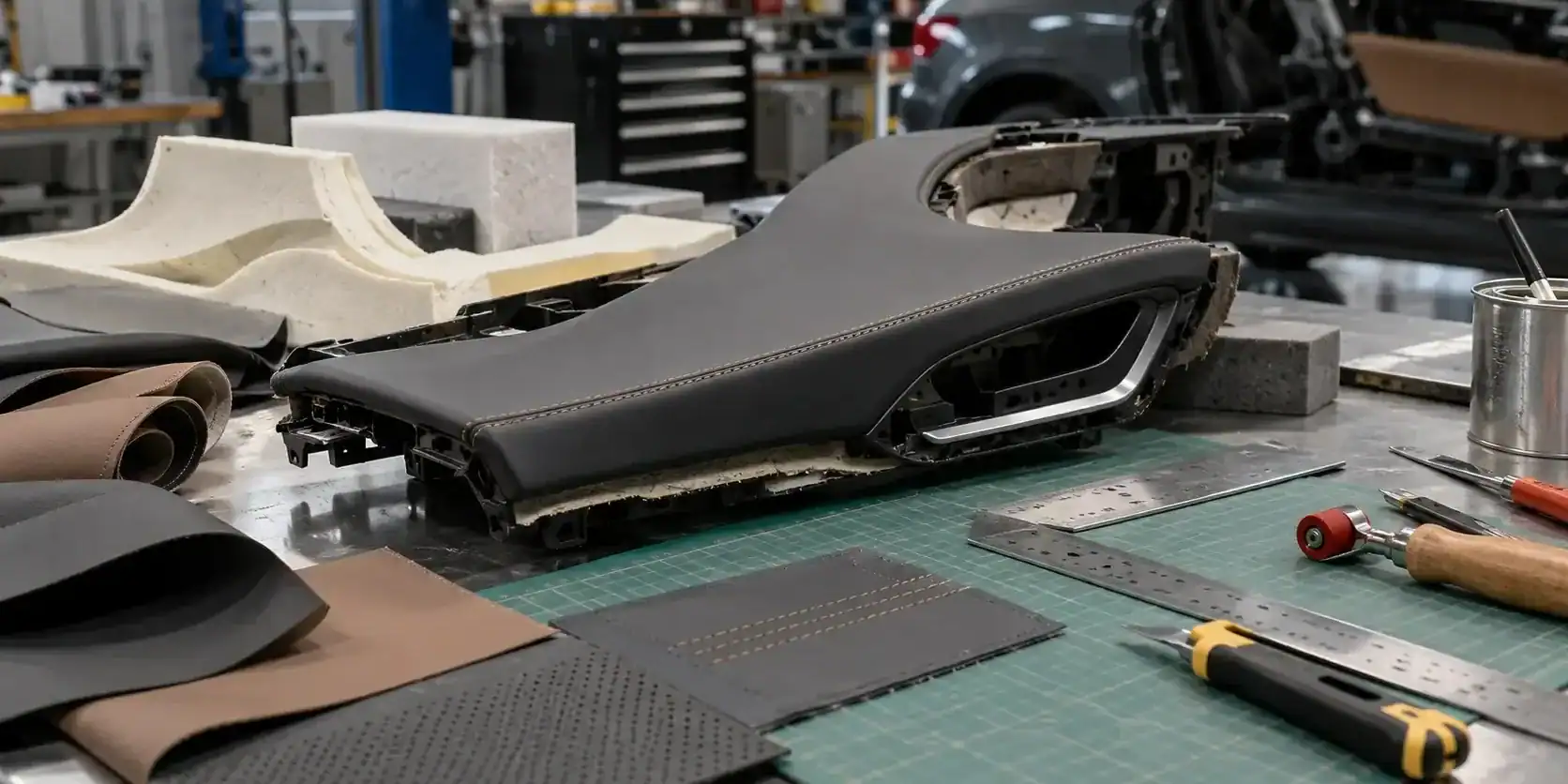
A material might look good and perform well in laboratory tests but still pose challenges in production. That is why the process trials must incorporate the actual design of the components as soon as possible.
The tests to be performed may include:
- material cutting, nesting and edge;
- machine and hand stitching as applicable;
- seaming behavior and stitch appearance;
- adhesive performance and compatibility;
- material lamination to foam, textile or rigid substrate;
- forming and wrapping around the actual geometry;
- material embossing, printing or foiling as applicable;
- any surface marking or damage while assembling;
- material edge finishing;
- material repeatability through multiple builds.
According to UNCAGED, ELEVATE material may be hand- or die-cut, laser-cut, machine- and hand-stitched, embossed, printed, foiled, bonded, and edge-painted. The company also says that its partners get a user manual. All of these capabilities suggest that manufacturing compatibility becomes one of the early evaluation criteria.
Nevertheless, the process compatibility remains application-specific because the adhesive chemistry, substrate, geometry, temperature, pressure, handling, and material revision can influence the results.
Compare Sustainability Evidence, Not Sustainability Labels
Terms such as plant based leather, vegan, bio-based, biodegradable, recycled, recyclable, and lower carbon may often appear together in sustainability discussions, but they describe different attributes and require different types of verification.
In comparing sustainable leather alternatives, examine:
- Bio-based feedstocks and animal-derived content;
- Presence of fossil fuels and synthetic compounds;
- Recycled content, when claimed;
- LCA functional unit and system boundary;
- Metrics such as water, energy, and greenhouse gases;
- Biodegradation testing conditions;
- The existence of a practical recycling process; and
- What the certification really certifies.
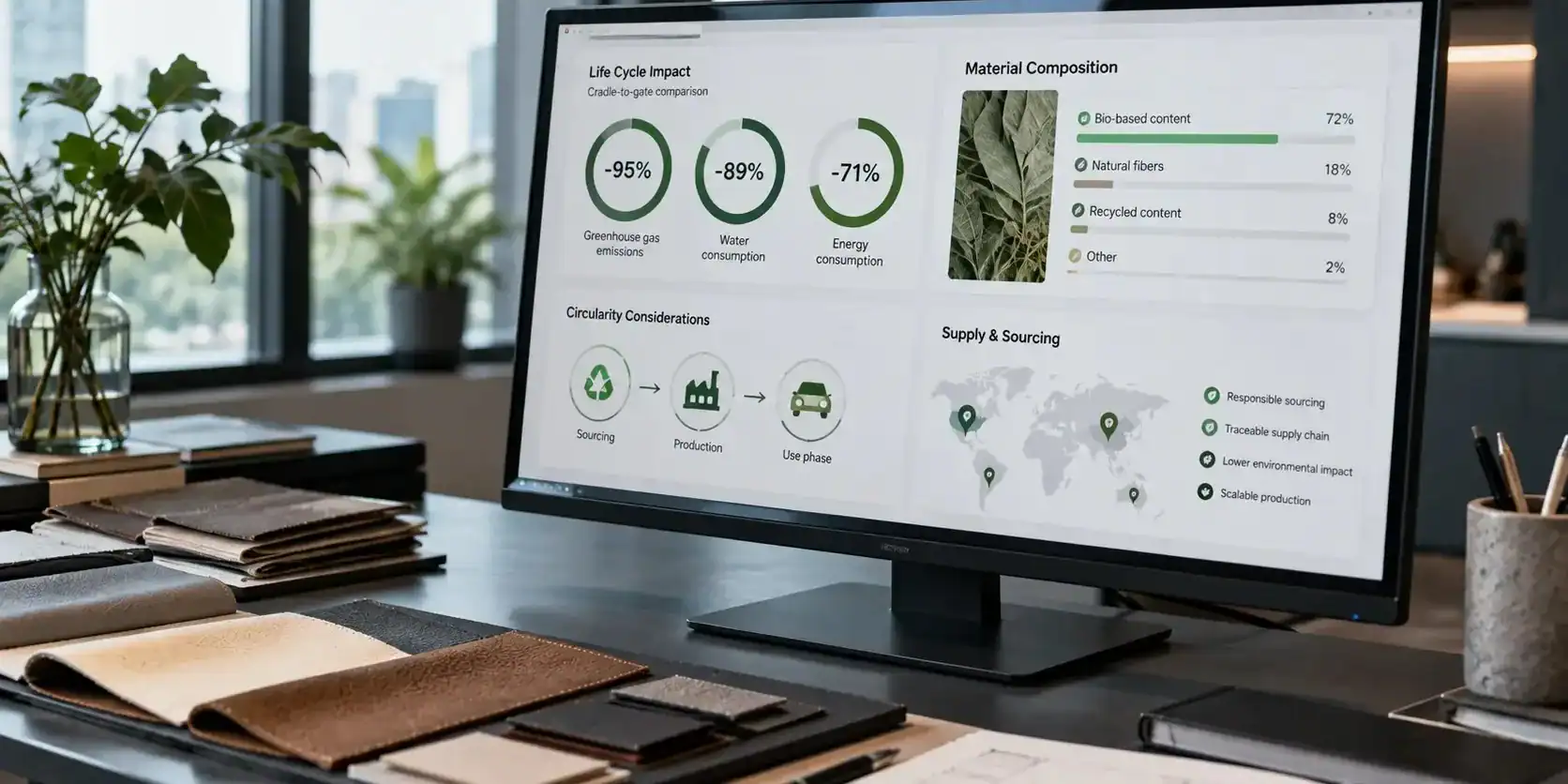
UNCAGED claims an independent cradle-to-gate LCA per one square meter of ELEVATE, which includes raw materials extraction, transportation, and processing through to production of the material. According to their environmental impact page, the material is estimated to have 95% lower greenhouse gas emissions, 89% lower water usage, and 71% lower energy usage compared to animal leather in that defined scope.
The certifications overview contains “USDA BioPreferred,” “FSC Certified Materials,” “PETA Approved Vegan,” and LCA. USDA BioPreferred is a program to verify biobased content of the certified products, but it does not certify automotive durability and flammability. LCA comparisons should also clearly define their functional unit and system boundary according to a standard, such as ISO 14040.
Validate the Material From Sample to Vehicle Program
The staged process prevents a well-formed sample from being regarded as a production-ready piece of evidence. The initial screening will show whether it is worth testing and if the supplier can provide all the necessary documentation. Larger samples ensure actual testing of cutting, sewing, gluing, or forming processes. Component prototypes highlight problems that cannot be detected with a flat material sample alone. Qualification tests the exact construction on the vehicle program, while the commercial review focuses on supply, quality, consistency, and change control.
UNCAGED samples can be used in the initial stages of testing, but their availability doesn’t mean that a material is ready for the vehicle component. Make sure you know the exact formulation used throughout the process.
| Stage | Material form | Main question | Evidence produced | Decision gate |
|---|---|---|---|---|
| Specification review | Documentation | Can the candidate realistically fit the program? | Requirements and supplier-evidence matrix | Proceed or stop |
| Swatch screening | Small samples | Does the appearance and basic construction fit? | Shortlist and open issues | Proceed or revise |
| Process trial | Larger material | Can it be cut, stitched, bonded, formed, or finished? | Process observations | Proceed or revise |
| Component prototype | Representative build | Does the material work in the real construction? | Prototype findings | Test, revise, or stop |
| Qualification | Exact formulation/component | Does it pass the required program tests? | Controlled test reports | Pass, revise, or stop |
| Commercial review | Production-intent material | Can supply and quality support the program? | Commercial and quality evidence | Nominate or hold |
Use Swatches for Screening, Not Qualification
Select samples based on where you are in the project rather than hoping that one little swatch will be able to answer all your questions.
A logical progression would be:
- Review the existing technical, compositional, and sustainability information.
- Look at the swatches for hand, grain, color, gloss, backing, and construction.
- Identify the construction that would warrant further processing trials.
- Progress to a bigger-scale material for cutting, stitching, bonding, forming, etc.
- Make prototype pieces before reaching any conclusions regarding performance.
The UNCAGED current sample program includes a sample book with 16 swatches in Nappa and Pebble finishes as well as 25 square foot production panels at 0.9 to 1.1 mm in thickness.
This information is relevant to the current sample offering for Signature but not necessarily to every automotive offering of ELEVATE. There might be a completely different construction in an automotive application, so sampling would be done to determine the need for further testing.
Prototype With the Real Component Process
The good prototype should represent all the essential elements of the construction of the component itself. This involves using the realistic geometry, substrate, backing, foam, adhesive, stitch pattern, forming process, edge finishing, and assembly conditions where possible.
In conducting the test, one needs to observe the following elements:
- surface stretching/ wrinkling/ marking/ recovery;
- cut edges behavior;
- material distortion due to seams;
- adhesive impact on the visual and tactile properties of the surface;
- behavior of the surface when going along the curves;
- consistency of embossing/ any other finish;
- consistency of multiple builds.
The feedback from the prototypes will be useful for both changing the process parameters and materials used. According to UNCAGED, BioFuze can be used to tailor the ELEVATE to the desired thickness, texture, color, strength, and flexibility. After the modification, connect it to the requirements, identify the new material version, and retest any elements that could be affected by the change.
Test the Exact Formulation Against the Exact Specification
The test data will be valuable only when it refers to the specific material and requirement under consideration in the approval program.
It is recommended to verify:
- material and requirement formulation and revision;
- color, finish, coating and backing, if applicable;
- specimen or component construction;
- revisions in OEM or Tier 1 specification;
- method of testing and its deviation agreement, if any;
- exposure time and conditioning procedure;
- acceptance criteria;
- laboratory and report dates; and
- tested material identity with respect to its production version.
Even though test data is correct, it does not mean that it should be considered in the program. For example, SAE J2412 may specify exposure duration and exceptions in the manufacturer’s specifications. The same situation takes place for abrasion, flammability, emissions, fogging, cleaning, colorfastness, etc.
Verify Scale, Consistency, Supply, and Commercial Terms
Technical qualification is not sufficient without the ability to deliver the material in the correct form, at appropriate quality levels, and according to a schedule that is compatible with the vehicle program.
Before nomination, verify details like roll width and format, lot-to-lot control, commercial MOQ, custom development MOQ, lead time, manufacturing site, quality documents, change control process, capacity, ramp assumptions, and pricing. In addition, for the custom formulation, confirm how the formulation is locked and communicated, and how any subsequent changes are revalidated.
As per the UNCAGED description about the ELEVATE program, it is described as fully scaled and that it can be manufactured in 2,000-meter rolls within days. They have mentioned that they manufacture in the US and work with partners across the globe. These indicate commercial-scale capability, but are not evidence of their annual automotive capacity, PPAP readiness, delivery schedule, or quality system.
Verify your project requirements directly with the UNCAGED team.
Use a Stage-Gate Decision Before Nomination
A basic stage-gate process prevents an attractive material from being progressed faster than the available information warrants.
- Requirements gateThe component, market, specification, threshold, and documentation requirements are known.
- Evidence gateThe supplier has adequate and pertinent information to warrant prototype development.
- Prototype gateThe material performs adequately in the planned construction and process.
- Qualification gateThe exact formulation and component construction are qualified through program testing.
- Commercial gateQuality, consistency, volume, cost, availability, documentation, and change control are acceptable.
In each phase, the output remains uncomplicated: move forward, revise, wait, or quit. An attractive sample or good test results in general should not be sufficient reason to consider a material for production.
A formulation revision does not automatically mean that the entire project starts back at the beginning. Instead, the team can revert to the phase affected by the revision if it maintains accurate documentation of changes and previous applicable test results.
Examples: How Priorities Change by Interior Use
Automotive upholstery varies widely, and not every part will experience the same stresses in real life. Depending on whether it is a seat, wrapped trim, or advanced interior trim design, different testing and prototyping may be required, and design may need to take priority over technical aspects.
Below are some hypothetical scenarios to illustrate the versatility of the evaluation system. Public work with Hyundai and JLR proves that there was automotive development that involved ELEVATE; however, it does not prove production qualification for the components described below.
| Example scenario | Top priorities | Evidence to request | Prototype focus | Decision trigger |
|---|---|---|---|---|
| High-contact seat surface | Wear, flex, seams, cleaning, safety, cabin air | Program durability and interior-material tests | Sewn and bonded seat construction | Required durability and safety gates closed |
| Wrapped trim surface | Formability, bonding, edge quality, exposure, appearance | Process, aging, fogging/VOC data | Real geometry and substrate | Stable build and required exposure results |
| Premium innovation program | Aesthetics, customization, sustainability, scale, qualification path | Material, LCA, process, supply, and test evidence | Multiple controlled iterations | Evidence supports the next development stage |
Example Scenario: High-Contact Seat Surface
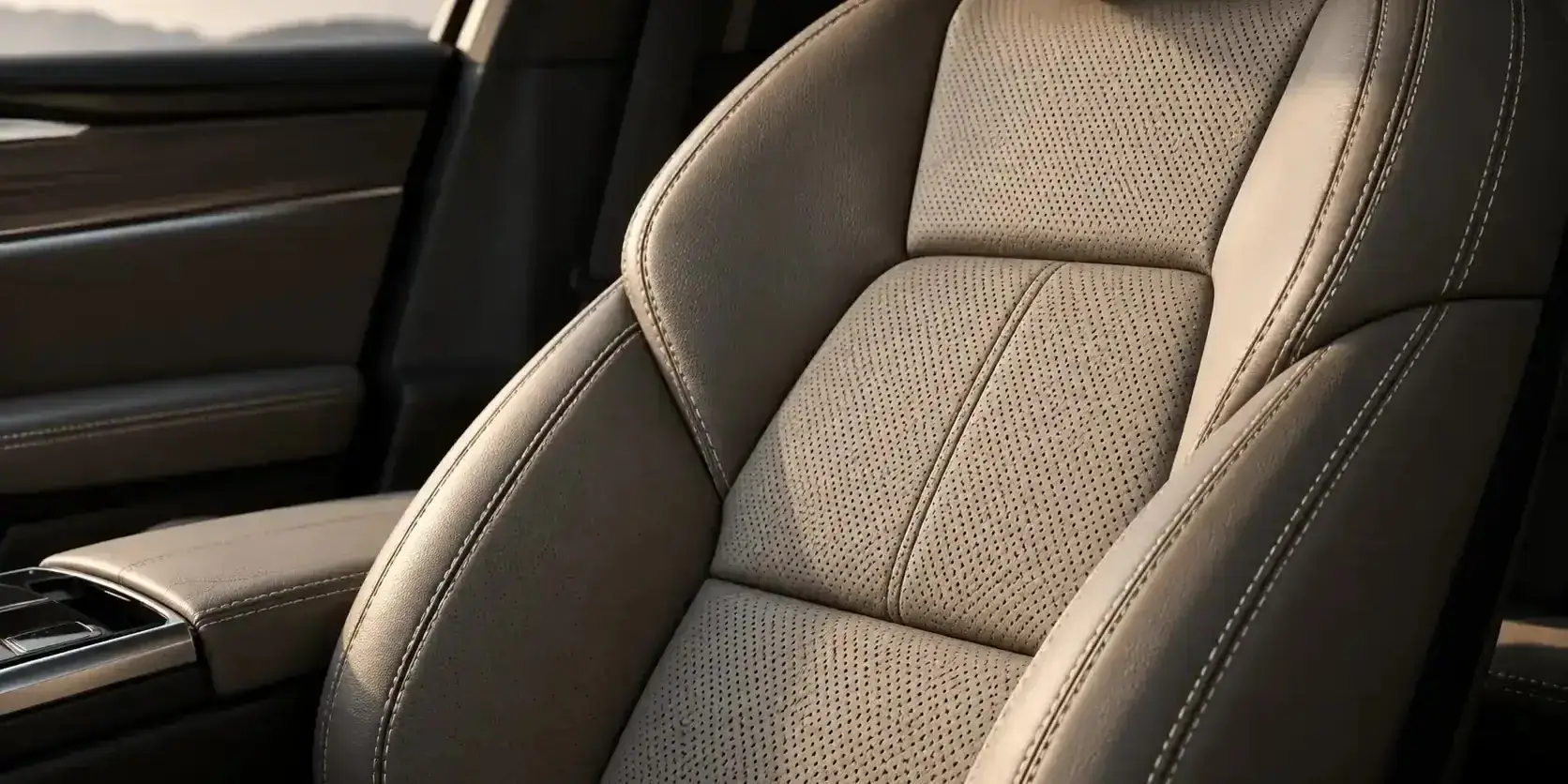
Car seats are amongst the most challenging uses of materials as there is continuous contact, pressure, movement, heat, cleaning, and visible wear.
When evaluating an automotive seat upholstery material, the following factors should be considered primarily:
- abrasion and flex resistance;
- seam durability;
- color migration/crocking;
- exposure to skin oils, sweat, make-up and cleaning agents;
- thermal and light aging;
- comfort and tactile properties when used;
- flammability and cabin-air specifications if applicable;
- consistency of color and appearance on large material pieces.
If required by the specification, the automotive seat upholstery material must also be tested within the seat assembly. Backing, foam, glue, seam configuration, and other layers may affect the final performance of the assembly.
A good Martindale test result is helpful, but it is not sufficient to consider an automotive seat material qualified for a specific vehicle program. If any durability, safety, chemical, or cabin-air tests were not completed at this stage, then the material must remain in a prototype and qualification phase.
Example Scenario: Door or Wrapped Trim Surface
Wrapped door insert surfaces and other wrapped trim surfaces impose a different set of criteria on materials compared to high-wear seats. Unlike seating, which requires high wear resistance and good forming properties, wrapped trim usually requires different criteria, such as forming capabilities, bonding capabilities, and a clean appearance after forming.
Main aspects of material evaluation will be:
- forming capabilities;
- adhesive and laminate compatibility;
- clean cutting edges and trim definition;
- consistency of grain/embossing pattern after forming;
- abrasion resistance;
- heat and light exposure performance;
- color and gloss consistency;
- fogging and VOC requirements;
- reproducibility.
Materials that perform well as flat sheets may behave completely differently when wrapped and bonded to substrates. Wrinkling, marking, delamination, and change in gloss level may become visible only after the manufacturing process.
Therefore, prototype testing should be performed on the real substrate, with real adhesive, geometry, and manufacturing process. The general evaluation approach will be the same; however, evaluation criteria should be changed according to the component.
Example Scenario: Premium Interior Innovation Program
A materials innovation program might start before the OEM chooses its final component or production program. At this point, the team might still be investigating issues such as touch quality, custom colors and grain, reduced environmental impact, processability, scalability, and animal-free material solutions.
The question at hand should not be, “Is this ready for production?” but “Is there enough technical and commercial viability for further development?”
This is consistent with the publicly available information on UNCAGED. As of August 2025, the official announcement by Hyundai mentions that “Hyundai CRADLE and UNCAGED partner in developing sustainable, animal-free leather alternatives for automobile interiors.” JLR’s 2026 Annual Report mentions that “JLR became the first OEM to produce a proof of concept of an automotive interior with UNCAGED’s sustainable grain leather alternative.”
UNCAGED also reports the Hyundai collaboration and JLR proof of concept. These cases represent ongoing development within the automotive industry and not actual serial production.
Common Mistakes When Selecting Automotive Alternatives
These errors are always costly since they are discovered at an advanced stage in the process. A team can take weeks to perfect the grain, color, or stitching of a garment and then realize the compulsory emissions were never addressed. Similarly, a good lab test does not guarantee success when the procedure, sample, or threshold is not compatible with the program.
The same applies on the commercial side, where a successful prototype is not enough if the format, lead time, quality control processes, lot consistency, or change process does not enable the material to move into production.
The best strategy to overcome this is to determine what could cause the material to fail and gather evidence before going into deeper development stages.
Choosing by Look, Feel, or “Plant Based” Positioning Alone
The use of a swatch allows assessing color, texture, hand, grain, backing, and perceived quality. However, it will not indicate whether the material meets the criteria of a vehicle program.
Some popular shortcuts are:
- selecting on a look and feel basis without first defining test criteria;
- equating “vegan” and “bio-based”;
- equating “bio-based” and “biodegradable”;
- believing that “sustainable” refers to lower environmental impact across the board;
- thinking that a premium hand implies great abrasion, aging, and/or chemical resistance.
Material terminology matters since each definition serves a different purpose. A plant-based leather claim, for example, does not automatically mean a material is biodegradable or free of synthetic components. UNCAGED’s definitions of bio-based and biodegradable materials are helpful because these terms are related but not the same.
A better approach would be to examine material composition, relevant technical reports, sustainability data, any applicable certification(s), and the material’s qualification program. Appearance needs to assist the team in choosing from the group of materials that satisfy the test criteria.
Treating General Test Data as Automotive Approval
“Testing” could mean any one of a multitude of very different things.
It would be helpful to distinguish between:
- general material test result;
- result obtained following a specified standard;
- result obtained relative to a particular customer-specified threshold;
- component-level validation;
- OEM or Tier 1 qualification;
- production nomination.
The UNCAGED-published ELEVATE results clearly demonstrate the importance of such distinctions. Test results above 10,000 Martindale abrasion cycles and 100,000 Bally Flex cycles represent valuable material information, but they do not indicate whether a particular formulation would meet the requirements of SAE J948, SAE J2412, FMVSS No. 302, OEM-specific testing, or some other program goal.
A number is only meaningful for qualification purposes if the test methodology, sample, conditioning, formulation, test result, threshold, and intended application are known. Otherwise, consider it screening data.
Ignoring Manufacturing, Supply, or Change Control
Even if a material performs well in tests, it may still have manufacturing and supply challenges.
Typical late-stage problems are:
- variations in performance of the material under cutting, wrapping, bonding, or stitching;
- incompatibility of the material with the chosen type of glue or laminating technique;
- visibly different colors, gloss, grain between batches;
- manufactured material that does not match the material tested;
- MOQ or delivery time that does not meet program needs;
- absence of documents necessary for quality assurance;
- changes in formulation or finish without a proper notification process;
- neglecting repetition of relevant tests after changing the material.
The manufacturing and supply conditions should be taken into account at the qualification stage, not at the purchasing stage. One should ensure that the material version used during testing can be traced, and that any material change triggers a review of the tests that must be repeated.
This is crucial for customizable biomaterials. Material flexibility is useful, but only if each material variant is well controlled.
Expert Tips for Automotive Material Evaluation
An efficient development process should aim to detect the critical mismatch at an early enough stage, when not much time and money have been spent. Always link the program specification, supplier documentation, material revision, prototype, and testing outcomes, so that everyone always knows which outcome pertains to what.
It may also help to schedule activities based on the risks they contain. The easiest attribute to prove may not be the most important one to verify first.
From a materials innovation perspective, ELEVATE is relevant because it is a customizable material platform rather than a pre-developed automotive part. According to UNCAGED, the thickness, texture, color, strength, flexibility, and finish can be modified, and the company provides a performance report upon request along with material handling guidelines for partners. However, each new iteration still needs to be evaluated against the real vehicle program specifications.
Ask for the Evidence Package Before Deep Prototyping
Before starting design and engineering for complex parts, request basic information to determine whether the candidate qualifies for further engineering work.
This could include:
- a current technical data sheet or material specification;
- information regarding formula and build;
- any performance reports relevant to the application;
- sustainability and LCA information;
- appropriate certification information;
- an applicable manufacturing or user guide;
- identity of sample being evaluated, revision number;
- limitations;
- format of material currently being tested, MOQ, lead-time information;
- quality and change control information.
These considerations may uncover a deficiency in flammability, emissions, exposure, or some other important requirement before the team spends time on cosmetic development or complex prototypes.
According to UNCAGED, the complete ELEVATE Performance Report is available upon request, and the factory and brands will receive a user manual. Find out what information is contained within those documents for this specific formula being reviewed rather than expecting a generic report to have all required automotive testing information.
Test the Hardest Requirement Early
Now that you know what the requirements are, choose the one that is most likely to disqualify the material or require the longest time to solve. Try this one first.
This may vary according to the program, but it could be any of the following:
- flammability;
- acceleration due to light or heat;
- VOC or fogging restrictions;
- abrasion or cyclic flex;
- forming into an intricate shape;
- adhesion properties;
- a customer-driven performance benchmark.
There isn’t just one “toughest automotive test.” This varies by component, construction, target market, material architecture, and OEM specifications.
If there’s one test that is going to stop you in your tracks, it’s better to know about it sooner rather than later. Otherwise, a lot of expense will be wasted in trying to optimize colors and grain.
Treat Customization as an Engineering Loop
Customization works best when you treat it as an engineered solution rather than an open-ended design challenge. Begin with a defined requirement, determine the material property that can influence it, develop an adjusted design, create a prototype sample, measure its effect, and determine if another adjustment is necessary.
UNCAGED has established that thickness, texture, color, strength, flexibility, and surface finish are all variables that could be tuned on ELEVATE. This allows product development teams to customize the appearance, composition, feel, and performance of their products rather than having to make the same stock material fit any number of applications.
Traceability is critical. Any adjustments to thickness, backing, coating, or formula require establishing a new sample and determining which previous test data remain applicable. An adjustment designed to improve one performance characteristic will also have impacts on processing, emissions, appearance, and other performance properties.
Customization should be kept to a measured requirement and not a commitment to be able to meet any specification automatically.
Statistics That Matter in the Material Decision
While a percentage or test result may seem simple enough, it can be deceptive if not put into context. LCA values only have meaning in the context of the chosen functional unit and system boundary. Link durability values to a specific testing methodology and, when applicable, an acceptable threshold. Recycled content and bio-based content also need to be separated from each other.
Include all information related to the data behind an important figure right next to it. While the publicly available data on performance and LCAs provided by ELEVATE can be helpful in initial material selection and sustainability assessment, it alone does not prove compliance with a particular vehicle program. The EU circularity requirements may help give some perspective about traceability and material content, but they need to be considered separately from ELEVATE’s composition and performance data.
| Statistic | Source and scope | Why it matters | What it does not prove |
|---|---|---|---|
| More than 10,000 Martindale cycles | UNCAGED general ELEVATE performance data | Initial abrasion screening | Automotive abrasion compliance |
| More than 100,000 Bally Flex cycles | UNCAGED general ELEVATE performance data | Initial flex screening | OEM flex qualification |
| 16 hours water-resistance testing | UNCAGED general ELEVATE performance data | Initial exposure context | Universal water resistance |
| 95% lower GHG emissions | Independent LCA reported by UNCAGED, cradle-to-gate, 1 m², versus animal leather | Environmental sourcing comparison | Full lifecycle superiority |
| 89% less water | Same LCA scope | Water-impact comparison | End-of-life performance |
| 71% less energy | Same LCA scope | Energy-use comparison | Automotive qualification |
| 10–12 million vehicles reach end of life annually in Europe | European Commission context | Shows the scale of the circularity challenge | A requirement specific to ELEVATE |
| 15% recycled plastic from 2032, 25% from 2036 | EU vehicle circularity rules | Signals stronger material traceability and recycled-content requirements | Equivalence between bio-based and recycled content |
Published ELEVATE Performance Numbers
At present, according to the contact page of the UNCAGED website, ELEVATE surpasses:
- 10,000cycles in Martindale abrasion
- 100,000cycles in Bally Flex
- 16hours in water resistance test
The above information goes beyond appearance and can be useful in preliminary material selection. It is stated that UNCAGED can provide the performance report upon request.
The crucial thing here is not to attach too much significance to the numbers. The summary data is not sufficient to make an opinion on whether the material fulfills the automotive standard in question. Any result obtained must be associated with the test methodology, formulation, sample construction, conditioning, pass level, and application.
Only after analyzing both the performance report and the vehicle program specification, one can consider the above numbers to be qualification data.
ELEVATE LCA Figures and Their Scope
UNCAGED provides a standalone cradle-to-gate Life Cycle Assessment (LCA) of one square meter of ELEVATE. This LCA accounts for the product’s raw materials, raw-material transportation, and the manufacturing process.
The LCA compares ELEVATE to animal leather by reporting the following:
- 95%fewer greenhouse gas emissions
- 89%less water usage
- 71%less energy usage
This information could be valuable when evaluating the different materials being sourced, yet it needs to be interpreted in the proper context. The functional unit, system boundaries, and assumptions made throughout the study must remain clear whenever the numbers are referred to.
The LCA does not include the full life cycle of a complete vehicle interior product. The product’s longevity, repairability, recyclability, end-of-life performance, and compliance with the technical specifications of a specific automotive program are not included in the data.
Therefore, the LCA numbers should be looked at in conjunction with the material’s durability, safety, manufacturing, and qualifications.
Having this information clear makes the sustainability comparison more valuable and credible.
Automotive Circularity Context in the EU
Vehicle policies in Europe are focusing on material information tracing and end-of-life plans. According to the European Commission’s overview of vehicle circularity, around 10 to 12 million vehicles reach end-of-life each year in Europe.
The End-of-Life Vehicles Regulation, which became effective on August 13, 2026, is expected to apply from September 1, 2028. Some of the initiatives include recycled plastic content of 15% after 2032 and 25% after 2036 in new vehicles.
This means that automotive material departments require increasing information regarding composition, source, recycled content, and end-of-life plans. This does not mean bio-based content will automatically count toward recycled plastic content goals.
Thus, ELEVATE must be judged based on the composition details, bio-based certification context, LCA data, performance data, and test results. Circularity claims can be made separately unless there is a concrete plan to recover, recycle, or reuse the material.
Public Automotive Development Evidence
OEM collaboration can be an important step in materials innovation because it moves a material from a concept toward real vehicle development. However, development collaboration does not necessarily mean production nomination.
A collaboration could consist of formulating the material, prototype tests, feasibility studies, etc. A proof of concept could demonstrate the material’s potential applicability in an automobile interior without disclosing all qualification data.
For ELEVATE, the public domain documents allow the following descriptors: “automotive material development,” “OEM collaboration,” and “vehicle interior proof of concept.” The following descriptions should not be used at this time: “Hyundai or JLR production automobiles use ELEVATE” and “all ELEVATE formulations have passed one universal automotive test set.”
Verified Public Automotive Evidence
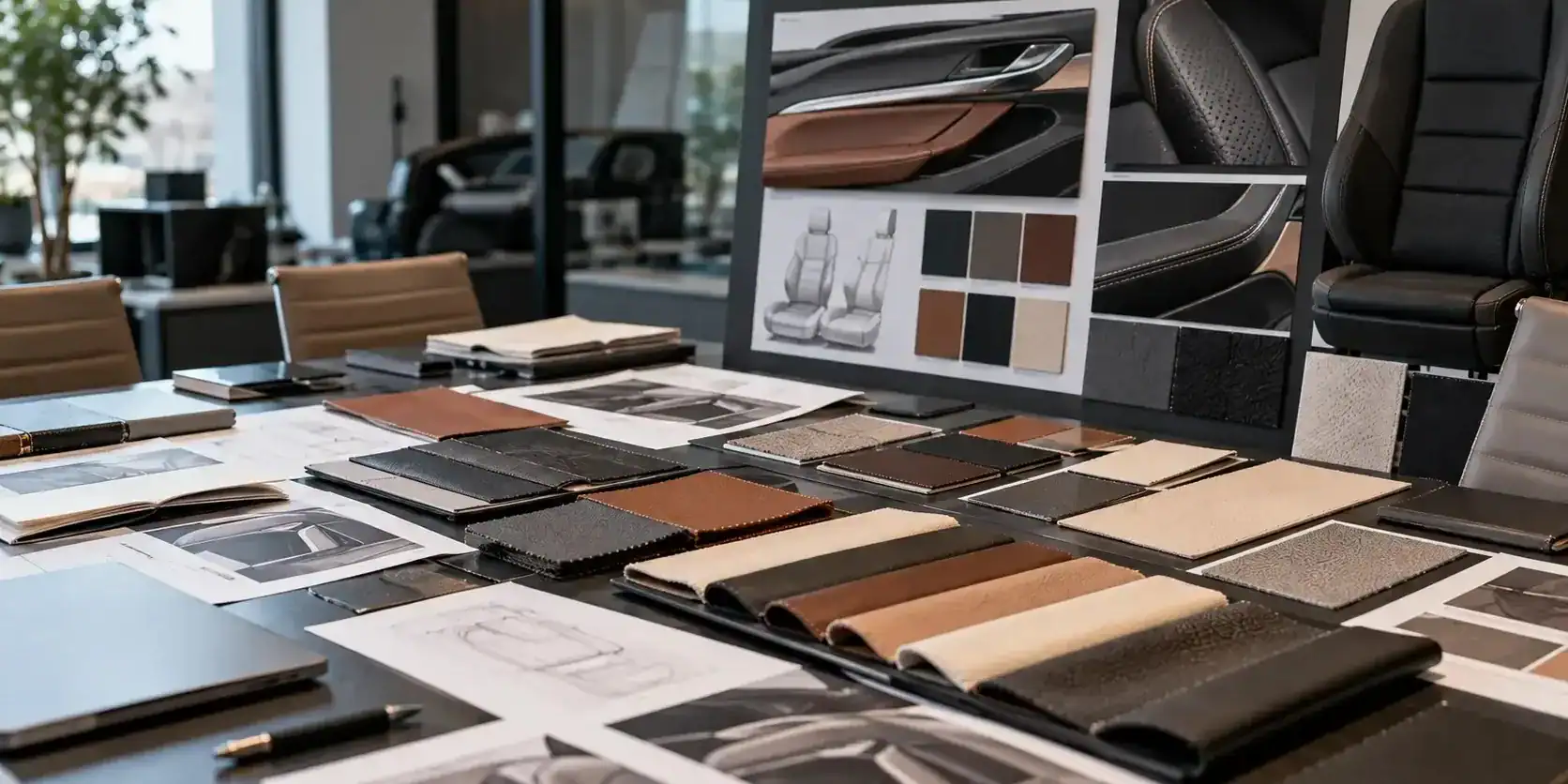
On August 21, 2025, Hyundai Motor Company announced that Hyundai CRADLE, the company’s global innovation center, is collaborating with UNCAGED Innovations to develop sustainable, non-animal leather alternatives for car interiors. The announcement introduces a grain-based biomaterial and highlights efforts to develop advanced, high-performance biomaterials for automotive applications.
According to JLR’s 2026 annual report, JLR became the first OEM to develop a vehicle interior proof-of-concept based on UNCAGED’s grain-based sustainable leather alternative. UNCAGED’s collaboration page also utilizes the same proof-of-concept terminology.
These two examples demonstrate the ongoing OEM-focused development efforts. It is important to avoid converting the development efforts into claims about serial production, approved materials, yearly output volumes, dates of production start, or any other information not available publicly yet.
For a new vehicle program, the information above is sufficient for further consideration of the material. The next step is analysis of technical documentation and qualification evidence for the component under development.
Conclusion: Choose by Evidence, Then Qualify
In selecting a leather substitute for use in vehicle interiors, one must start with the application rather than the material class itself. Begin by identifying the component, market, construction, and hard requirements. Identify applicable regulatory, OEM, and Tier 1 tests; then compare material construction, durability, cabin air and safety data, manufacturability, sustainable performance, supply chain, and commercial readiness.
As the project progresses, the evaluation will become increasingly realistic. Start with material samples for early screening, larger pieces for process testing, actual component geometries for prototype development, actual formulation for qualification, and production intent material for commercial review. When changing formulations, identify which earlier testing results remain valid and which requirements must be retested.
Sustainable leather alternatives may have credible automotive applications when they receive the same level of attention to durability, manufacturability, quality, availability, qualification, and environmental performance. Any one number from an LCA study or performance data will not suffice for this comprehensive approach.
Teams assessing a bio-based leather alternative may review the ELEVATE material, learn about UNCAGED’s automotive development program, including our work with Hyundai and JLR, and order ELEVATE samples for initial assessment. For a detailed discussion of our formulation, thickness, texture, color, performance data, testing requirements, MOQ, and scale, please contact us.
Ready to evaluate ELEVATE for your program?
Frequently Asked Questions About Automotive Leather Alternatives
How should sourcing teams treat supplier sustainability claims?
When comparing sustainable leather alternatives, attributes such as bio-based content, vegan status, LCA results, biodegradability, recycled content, and recyclability should be assessed separately rather than treated as interchangeable.
What is the difference between a leather alternative and synthetic leather?
The leather alternative is a generic name that covers bio-leather, plant leather, coated leather, composite leather, and synthetic leather. The name synthetic leather suggests something synthetic, but not all leather substitutes qualify as such.
Can a plant-based leather alternative still contain synthetic components?
Absolutely. While plant-based leather might mostly be made up of biological materials, it might have a layer of synthetic material among other parts. It is important that consumers know what all the parts of such a product consist of.
Why does the backing layer matter in automotive upholstery?
The backing layer can influence the flexibility, dimensional stability, bonding, sewability, and surface properties in the molding process. In the assessment of automotive seat upholstery material, the backing layer should also be included in consideration.
Do different colors or finishes need separate material evaluation?
Yes, that might be required since variations in color, finish, or texture in an automotive seat material may imply differences in material structure and can impact performance. The team needs to see if any other information is required instead of assuming that differently colored or textured materials perform the same.
When should a material supplier be involved in an automotive development program?
If the material needs to have custom thickness, texture, finish, construction, or performance, then the supplier can be included early on in the development process. This will help with materials innovation since ELEVATE configurations will be considered along with the design specifications of the part.
What does “production-intent material” mean?
Production-intent material is the material intended to represent the construction, formula, finish, and supply format planned for production. Evaluating production-intent materials reduces the chance of qualifying a prototype that later changes before production.
Why should every tested material version have a clear revision ID?
The revision ID allows results to be tied to the exact material version that was tested. This helps UNCAGED and its partners understand which data remains applicable after changes to thickness, backing, coating, surface, finish, or formulation.
Why should automotive teams review material limitations as well as benefits?
The limitations give teams insight into potential risk factors before investing in tooling, prototypes, and material qualification. Suppliers should provide information on existing data, testing, known characteristics, and limitation evaluation.
How can automotive teams start evaluating ELEVATE?
Teams can start with available samples to assess texture, finish, and construction, then discuss the component’s intended use and technical requirements with UNCAGED.